Migrations are a phenomena that conjure up images of great feats of movement. For most of us, they signal springtime has finally arrived after a long winter—when the robins and hawks return from their winter ranges in the southern United States and northern Mexico. For others, it is the signal that winter is just around the corner when the distinctive V pattern and the calling of Canada geese fly overhead.
Many mammals also undertake yearly migrations, moving between winter and summer ranges. One may take an African safari to witness the great migration of wildebeest and zebra, as they chase greener grass and try to avoid being predated upon by lions and crocodiles. Or closer to home, there's the migration of barren-ground caribou in the Canadian North, crossing the open tundra with calves at heel.
Why Move?
For ungulates (hoofed mammals), migration serves two important functions. The spring migration often sees them move up in elevation in search of new green vegetation as the snow disappears. This vegetation is rich in nutrients and serves migrating females well as they reach their parturition (i.e., birthing) grounds. During fall migration, ungulates move to lower elevations to deal with upcoming winter conditions. The reduced snow depths there make it easier to access forage and increases their chances of survival.
With advancements in technology, such as satellite GPS tracking devices, we can better understand the annual cycles of migration. We are learning that this phenomenon is a dynamic one, with many ungulate populations being partially migratory. Some animals within the same population may be migratory, while others stay year-round on the same seasonal range.
Migrations in Peril
As we gain new insights, we are learning that great migrations are being lost. In a monumental paper in 2018, Tucker1 and co-authors examined the movement patterns of 803 individuals across 57 mammalian species throughout the world. They demonstrated that on average the movements of mammals in areas with high human footprint were one-half to a third of those in areas with low human footprint. They concluded that losing the ability to move has cascading consequences for species persistence, populations, and predator-prey interactions.
On the heels of this paper, the Global Initiative on Ungulate Migration (cms.int/en/gium) was established in 2020 to produce a global atlas of ungulate migrations, and stimulate research on the drivers, threats, and conservation solutions to maintain ungulate migrations. Key to developing conservation solutions is understanding how the slow and continued spread of the human footprint plays on the patterns and persistence of migrations.
Marathon Movers
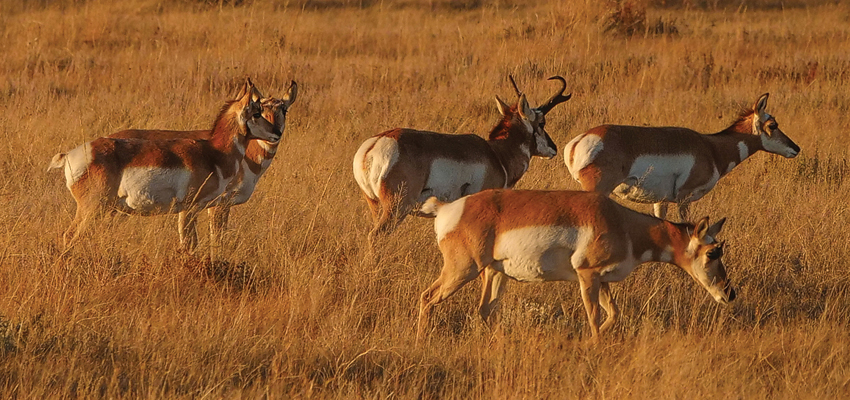
Pronghorn are an endemic species of the prairies of North America. Historically pronghorn followed the great herds of bison and had a symbiotic relationship with them, particularly during the winter. Today, pronghorn persist on the landscape from the prairies of Alberta and Saskatchewan, down through the western United States and into Mexico. The pronghorn's ability to migrate, especially at the northern periphery of their range, ensures long-term population persistence.
Between 2003 and 2010, Alberta Conservation Association (ACA) in partnership with government agencies, non-government agencies, and the University of Calgary, collared 185 pronghorn across the Northern Sagebrush Steppe. The area encompasses the grasslands and sagebrush steppe of Alberta, Saskatchewan, and Montana. The movement and migrations recorded on the GPS collars changed the way we viewed pronghorn.
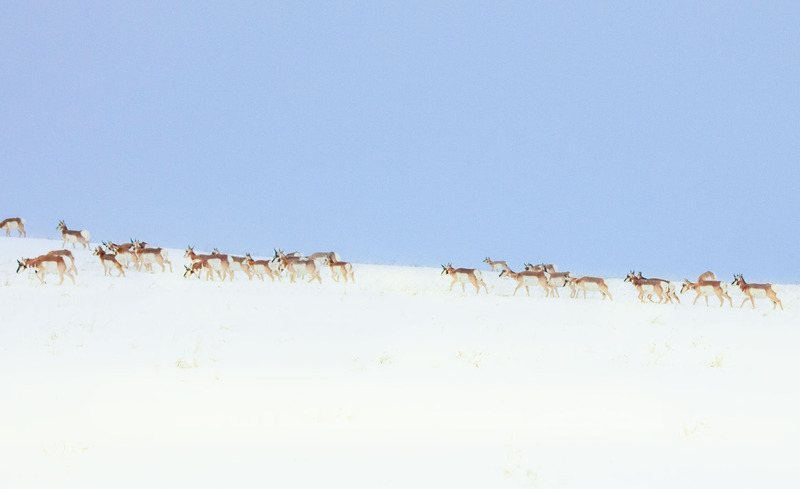
Based on the work of Dr. Jakes, we learned that pronghorn in this region are partially migratory, with 55% of the collared individuals making significant spring and fall migrations. On average, animals would migrate 162 km in the spring and 109 km in the fall. Of significance was the migration of Pronghorn #3, who completed the longest recorded year-round migration for the species, covering a total of 888 km in a 52-week span. We discovered that during severe winter snow events, individuals would leave their winter range and search out better conditions, moving up to 68 km south (called facultative migrations). The ability to migrate proved advantageous as they had a 7% higher survival rate compared to resident animals.
Risky Business
Migrating is not without risk and there is a trade-off between being a resident animal and moving to a new seasonal range. This means crossing highways, railroad tracks, fences, and rivers. During Pronghorn #3's year-round migration she crossed 13 major highways, one set of railroad tracks, thousands of fences, and three rivers. Her three-week 445 km spring migration at the end of March 2004 highlights the difficulties of long-distance movements. She spent three days moving back and forth on the south side of the Trans-Canada Highway east of Medicine Hat before successfully crossing and continuing north. For others, the crossing proves fatal!
Human Footprint
As with other ungulate migrations across the world, we are at risk of losing or changing the way pronghorn migrate across the Northern Sagebrush Steppe. Nowhere is this more evident than in Alberta. Since the initial study, our landscape has and continues to change dramatically. The ring-road around Medicine Hat that connects Highway 3 and Highway 1 has seen an increase in industrial and residential development to the extent that pronghorn may no longer be able to move freely through this area. Construction is underway to twin Highway 3 from Taber to Medicine Hat, which further hinders or eliminates the west migration route for pronghorn. Traffic along the busy Trans-Canada Highway continues to increase, making it even riskier to cross. And across the prairies we see solar and wind energy development projects popping up—with their impact on pronghorn migrations, movements, and habitat selection largely unknown.
Seeing the Evidence
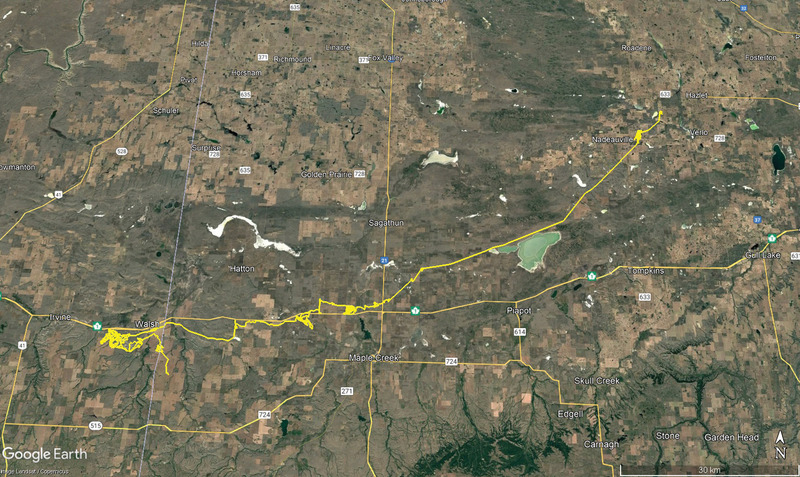
With this increase in human footprint and the possibility of losing migration, ACA initiated a new study. In December 2024, ACA deployed satellite GPS collars on 106 female pronghorn on the north and south sides of the Trans-Canada Highway in Alberta and Saskatchewan. The goal is to understand migration and movement patterns, how the changed anthropogenic footprint may be impacting pronghorn, and what might the population consequences be of these changed movements.
We are already seeing the impacts of the Trans-Canada Highway after just one month of data collection. Pronghorn #285 was captured north of Tompkins, Saskatchewan, near the village of Hazlet. On December 23, she began a southwest facultative migration and reached the Trans-Canada Highway north of Maple Creek on December 29. She continued westward, paralleling the highway until January 7 at which time she successfully crossed. She then paralleled the highway on the south side until entering Alberta on January 12. So far she has covered 110 km (as the crow flies) and where it takes her through the winter and into spring remains to be seen.
Helping Hand
Pronghorn #285's movement, and where she (and other pronghorn) are able to cross the Trans-Canada Highway, will assist in identifying areas that may be suitable for the development of an overpass (preferred by pronghorn) or wide-span bridge. Crossing structures reduce the risk to motorists and allow easier and quicker passage by pronghorn over the highway. The data from the collars will prove invaluable to the Pronghorn Xing (pronghornxing.org) stakeholder group to refine decisions on where to construct road enhancement structures in the future.
1 Marlee A. Tucker et al. Moving in the Anthropocene: Global reductions in terrestrial mammalian movements. Science 359:466-469 (2018). DOI:10.1126/science.aam9712
Photo credit (top): Bighorn Helicopters/ACA.