For the first time in many years, the Siksika Nation Blackfoot Tribe of Southern Alberta granted permission for a local club to host a pointing dog field trial on wild birds within the boundaries of their reservation. Early that spring, the club president contacted me, concerned that the snowy, saturated grounds would make moving people and dogs a challenge. Knowing that I own a Polaris dealership, he asked if I could participate and bring one of our all-wheel drive Rangers to pull the dog wagon.
I jumped at the opportunity. I typically run trials on foot, and this arrangement meant my bird dog, Holly, and I could compete without borrowing a horse. More importantly, I couldn’t pass up the rare chance to travel across these legendary prairie grounds untouched and full of history.
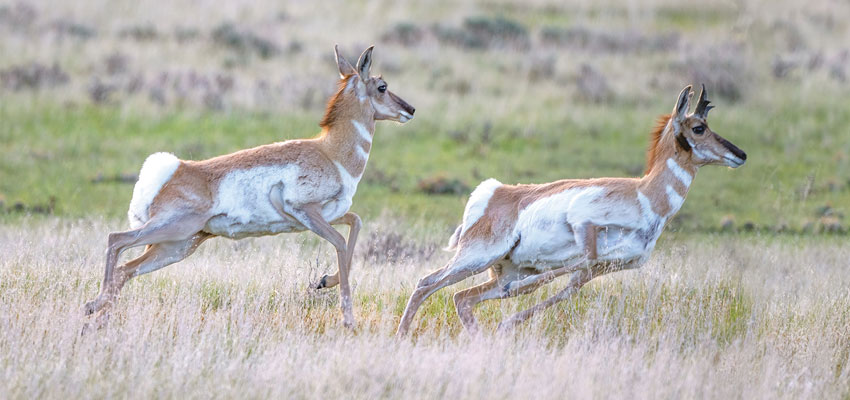
All the dogs were kennelled on the wagon, and pairs for each brace rotated out every 30 minutes, while handlers and judges followed on horseback. The landscape delivered everything I had hoped for and more. We encountered sharp-tailed grouse, pheasants, partridge, wild horses, whitetail and mule deer, songbirds, eagles, hawks, and coyotes.
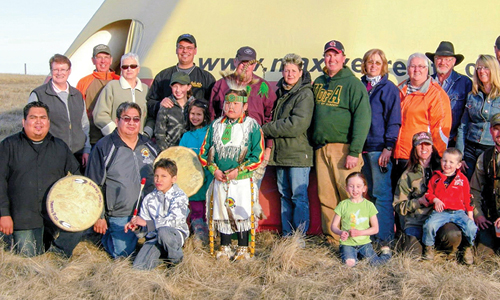
That evening brought a surprise that has stayed with me ever since. After a field-trial-style gourmet hamburger dinner, complete with a cold beer, we were joined by a Blackfoot Elder, his son, and grandson, each North American Championship dancers. With the vast beauty of the prairie still echoing in our senses, the Elder began to speak. What he shared was more than a story. It was a legend—a thread of memory woven from the heart of his people.
The Legend of the Chicken Dance
A long time ago, after a particularly brutal winter, a Blackfoot chief set out to hunt. His people were starving. The snow lay deep and unbroken, and the buffalo and deer had grown scarce. Whispers on the cold wind foretold the buffalo’s disappearance and harder times to come. In desperation, the chief turned to hunting prairie chickens. They too suffered through the long winter and were easy to catch.
After days of hunting the late-morning sun finally broke through, teasing the first real warmth of spring. The chief returned to his camp with a bounty of birds he harvested. He laid them out beside him, exhausted but satisfied, knowing he could feed his family. As the sun warmed his body, he drifted into sleep.
In that moment of rest, he had a vision. One of the grouse rose and began to speak, “Why are you massacring us?” It spoke of the hardship its kind had endured during the harsh winter. Just as the approaching spring brought a promise of new life, they were being slaughtered. “Are we to vanish like our brother, the buffalo?” The chief listened. He saw himself in the grouse’s suffering, its fear and desperation mirrored that of his own people.
Then the bird made the chief an offer, “If you stop killing us, I will make sure your tribe never starves again.” The chief agreed. “But with one condition,” said the grouse. “Each spring, your children and your children’s children must renew this promise.” The chief asked how they would do that. “By dancing,” the bird said. Then it began to dance—a wild, rhythmic, joyful dance.
The chief watched carefully. Finally, the grouse said, “Come, let us dance together.” The dance mimicked the movements of the prairie chicken rooster. Head bobbing, strutting, feet fluttered in a frenzy, while their bodies gently glided. Wings cupped, arms outstretched they performed the courtship ritual.
When the chief awoke, the sun was setting, and the prairie had grown quiet. The birds he had hunted still lay beside him, motionless. Remembering his vision, he returned to his people. He shared the tale and taught his children the dance. And so, the promise was kept.
After the Elder finished his story, his son picked up a hand drum and his grandson began to dance the Chicken Dance, right there in the heart of the prairie with the sun setting. It was moving, haunting—a powerful moment where history, culture, tradition, and legend came together. I came to the trial to lend a hand and run dogs. I left with a story I’ll carry for life.
What Happened to the Greater Prairie-Chicken (Pinnated Grouse)
I found myself returning to the words of the Elder, “Are we to vanish like our brother, the buffalo.” The words were a haunting foreshadowing.
Initially, European settlement brought a boom for the greater prairie-chicken in Alberta. Agriculture created ideal habitats, allowing the species to expand beyond its traditional southern range. Grainfields, cropland, and native grassland provided new food sources alongside nesting grounds. For a time, prairie-chickens thrived, spreading into the Canadian prairies where they had once been rare or absent.
This prosperity was short-lived. As agriculture intensified, native grasslands were plowed under. What had once been a diverse mosaic of habitat became a fragmented and increasingly hostile landscape for the grouse. Spaces that had once sustained life became barriers to survival. Gradually, the greater prairie-chicken lost its foothold in Alberta—and eventually, across all of Canada. The last confirmed sighting in Alberta occurred in the 1920s. The final sighting in Canada came in 1987, in Saskatchewan.
Spring on the prairies was once filled with the booming calls and dances of greater prairie-chicken courtship. Then, silence. The disappearance of the greater prairie-chicken isn’t just the story of a bird, but one of the land itself. How easily we forget the delicate balance it requires, and how quickly a promise, even one made in legend, can be broken.
Photo credit (top): Steve Oehlenschlager