Interested in bat conservation? Consider installing a bat house on your property. While they can be useful for some species of bat, many factors affect their usefulness.
What is a bat house?
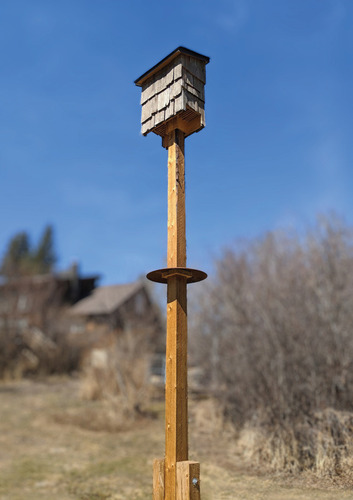
Bat houses are typically made of wood and provide shelter and a place to rest for some species of bat. They're typically used by maternity colonies—i.e., groups of mother bats and their pups—but they can also be used by males. Unlike birdhouses, bats enter by landing on a platform below the house and then claw their way up into the house. Bats are particular about their houses and also move around frequently—so a bat house may be used one day, but not the next. In Alberta, only two species of bat are known to regularly use bat houses: the little brown bat and big brown bat.
Do bat houses help bats?
Bat houses can be useful for bats, but only if built properly and placed in the right location. Unfortunately, most bat houses sold in stores are too small and unsuitable for maternity colonies. As bats require a relatively consistent temperature to thrive, they need to be able to move around in the house to be either warmer or cooler, depending on where the sun is—or have the ability to move to another, nearby house. A four-chambered bat house (or larger) is ideal, as is having a few bat houses in different locations—some in the sun, some shaded. Bats also return to their roosting sites year after year, so only put up a bat house if you intend for it to be there long-term.
Where should you put a bat house?
Put your bat houses in locations where bats are already active, or near suitable bat habitat (e.g., water, trees). However, don't put them right in natural areas, as you risk displacing other bat species. If you need bats to move out of a building where they're roosting, put up some bat houses nearby well in advance of their eviction. Place them at least 3 metres off the ground so cats can't get at them, and not in an area where predatory birds perch. Ideally, there should be multiple bat houses within 100 metres as bats regularly move between various roosting locations. It's good to have lots of options available, and working with your neighbours to put up multiple bat houses will help support a bat colony.
How can I build a bat house?
There are many bat house designs, with the two most common being the four-chambered bat house and the rocket box. You can build these yourself with some untreated cedar, pine, or exterior plywood, some screws, caulk or construction adhesive, and a few power tools. Bat houses should be at least 61 cm tall and 43 cm wide, while rocket boxes should be at least 1 m tall. You'll need a landing strip below the house entrance, so bats can land and climb up into the house. Roughen up the wood a bit to give the bats some grip. The interior chambers should be 2–2.5 cm apart, depending on the bat species you're targeting.
For help building and installing a bat house, visit Alberta Community Bat Program's bat house page at albertabats.ca/bathouses. Source material can be found here: www.ab-conservation.com/mag/sources
Photo credits: Cory Olson.